The Guild is fortunate to hold an extensive collection of embroidered pieces, notable for their historic and/or aesthetic significance. Here we focus on a decorative school sampler fashioned by early Brisbane resident Daisy Klumpp (think Klumpp Road, Mt Gravatt), who happened to be the great aunt of former EGQ President, Vice-President and tutor Joan Bird, whose gift it was in 2005 to the Collection.
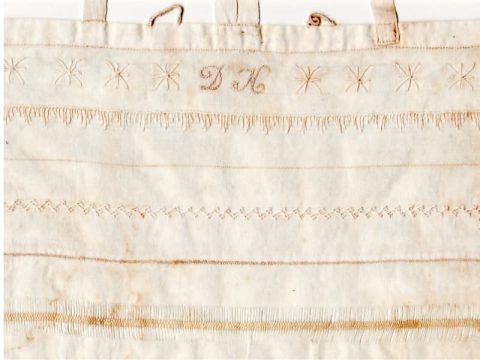
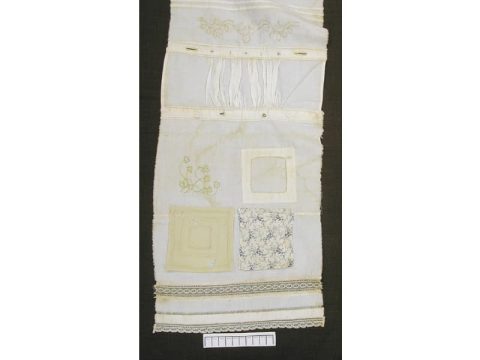
School Sampler by Daisy Klumpp, Nundau, circa early 1900s.
Born in 1893 to German immigrants Gottlieb and Frietricke (nee Heimerdinger) Klumpp, Daisy Klumpp was part of Brisbane’s first generation of European settlers.
Although initially residing at ‘German Station’ (Nundah), Daisy and her family later moved to a farm at Jimboomba – until her mother and brother’s untimely death by spear on the bank of Sandy Creek forced their return to Nundah. The children were immediately placed under the care of the Mission, where, among other things – including learning to play the piano – Daisy was taught basic needlework and sewing skills.
Some years later, the family moved to Mt Gravatt, and Daisy herself then moved to Greenslopes upon marrying Lachlan Howatson, with whom she raised 6 children. She and her immediate family enjoyed entertaining and travelling, and aided the war effort by billeting soldiers during WWII. Daisy maintained a love of crochet and needlework throughout her life. However, this may not have been the case had she not developed the home-making skills acquired through stitching the sampler held in the EGQ Collection.
Background
From the late 1800s until the late 1960s, Queensland schoolgirls were taught basic garment-making techniques including stitching, seam and buttonhole making, and patching. They had to practise on fine white cotton fabric, producing long narrow samplers that would demonstrate their skills in making, decorating and repairing clothes and household linen. All invaluable skills for future homemakers, particularly for those living during and after the War.
Among the skills Daisy and her cohort learned were:
• attaching different types of tape
• buttonhole stitch (useful for binding clothing and linen
• gathering (used in both clothing and household garments)
• patching (see the 4 different types on Daisy’s sampler)
• lacework (inserting and on the edge of the material)
• buttonholes and eyelets
• buttons, and hooks and eyes.
Daisy’s sampler
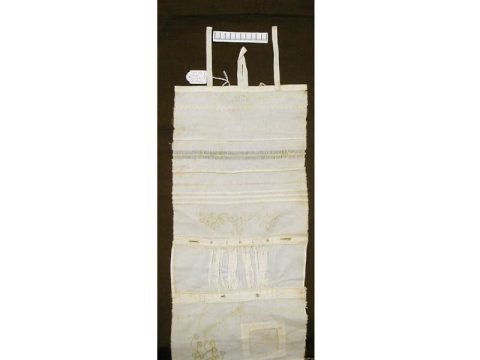
Worked over 19 rows in coloured thread on white cotton, the piece is in reasonable condition; however, it has some watermarks and has browned slightly with age.
Specific rows demonstrate:
1 – Tapes (3): one looped, one buttonhole and one chain stitched
2 – Algerian eye stitched and initial ‘DK’ between rows of pulled threads
3 – Buttonhole stitch on pulled thread rows
4 – Running stitch
5 – Double feather stitch
6 – Seam
7 – Pulled thread rows: herringbone in centre
8 – French seam
9 – Feather stitch
10 – 3 rows of upwards tucks.
11 – Stem stitch design
12 – Buttonhole worked eyelet (repeated across sampler).
13 – Gathered fabric
14 – 2 buttons(covered) and a hook and eye.
15 – Feather stitch worked on pulled thread rows.
16 – Stem stitch pattern and patch from self-fabric.
17 – Light wool fabric or flannel patch attached at top (floral fabric patch attached by buttonhole stitch at the top)
18 – Lace insertion with feather stitch
19 – Hem stitch worked into drawn thread row; lace attached to base.
Significance
Although typical of its time, Daisy’s beautifully stitched sampler is slightly different from others held in the Collection as it features several panels of decorative embroidery.
It demonstrates the range of skills taught in Queensland schools at the time and reflects the future needs of the maker and what was expected for a girl during this period. Its complexity also shows its importance to its owner.
Further information
The woman’s book – contains everything a woman ought to know, edited by Florence B Jack and Rita Strauss et al, London, 1911
A range of samplers produced from the early 1700s until today are held in the EGQ Collection. The most closely related to Daisy’s sampler would be those worked by Alice Castledine in 1884 (S72.18) and Ivy Acutt from Rockhampton (S0082 19/1). Each demonstrates specific skills, but individualised with differing sequences and embellishments. Girls in later years produced smaller samplers that emphasised embellishing rather than the basic sewing skills.