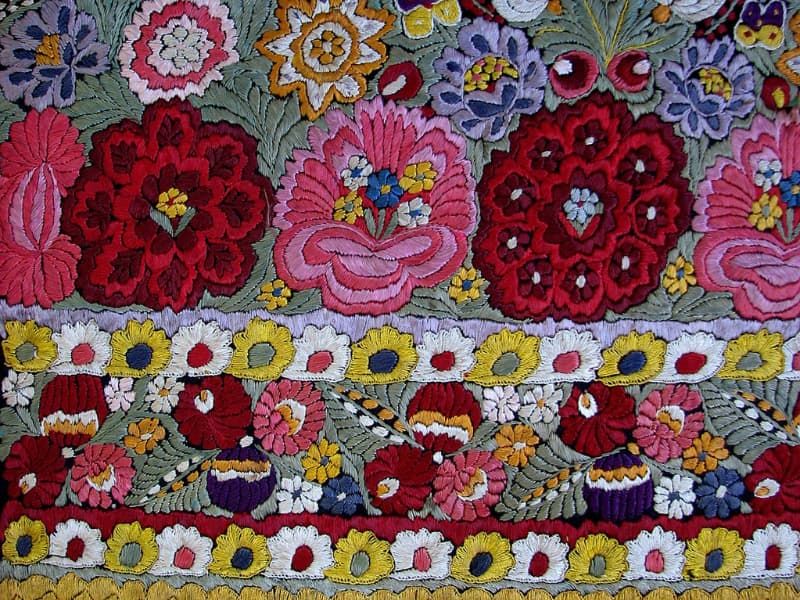
The importance of communication from home and to home for the soldier cannot be underestimated. This sentiment is highlighted not only from the contents of letters and correspondence that remain from the First World War but also from comments of those soldiers serving in current deployments and campaigns.
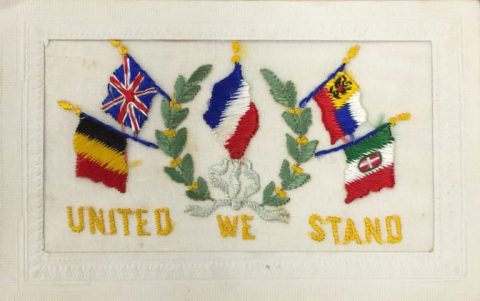
The silk postcard is synonymous with a by-gone era. Woven silk postcards were first produced in Krefeld, Germany in 1898 and were known as Stevengraphs. These early picture postcards were woven on machines and appeared as a combination of printed postcards and large woven silk pictures. The hand-embroidered silk postcard was first made in 1900 for the Paris Exhibition. The cards’ popularity peaked during the First World War (1914 – 1918) and it is estimated that 10 million Silks were produced at this time.
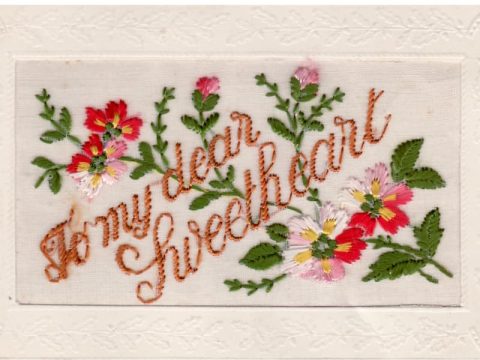
The cards produced from the First World War are exquisite particularly when one considers the conditions and circumstances in which these cards were made. A high level of skill within both the design and construction can be observed. Several themes dominate:
· Family,
· Remembrance,
· Liberty,
· Unity,
· Souvenirs of France and Belgium,
· Souvenirs of the war, and
· Regimental badges and crests

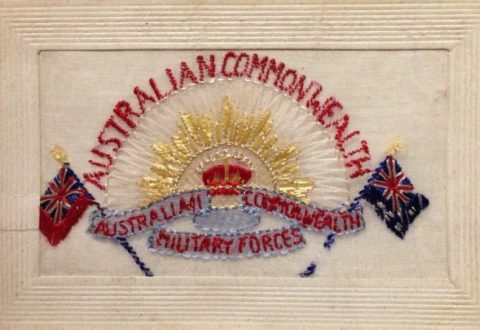
The Rising Sun postcard is from an EGQ member’s (N. Detering) personal collection.
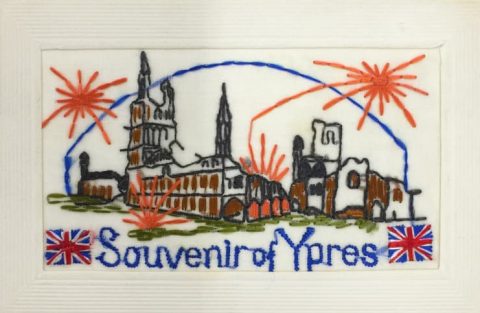
A rare example of destruction. This postcard is from EGQ member’s (N. Detering) personal collection.
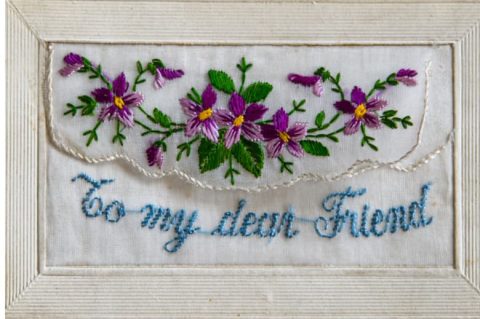
The subjects of the cards were a response to the demand of the principal clientele: the military personnel who were engaged in devastating war and conflict. It is rare to locate a Silk that alludes to the destruction of war. Rather, the Silks convey messages of affection and hope to those from whom the soldiers were separated. A sentimental theme dominates with not only the messages of “I long to see you,” “My thoughts are at home,” and “You are ever in my dreams;” but also the symbolic incorporation of foliage and flowers within the design. The colours are bright and inviting. The beauty of the embroidered silks would have offered a marked contrast to the grim existence found in the trenches and camps.
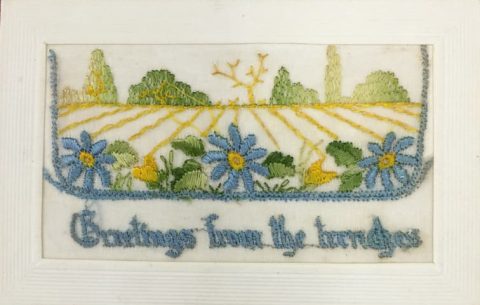
This postcard is from EGQ member’s (N. Detering) personal collection.
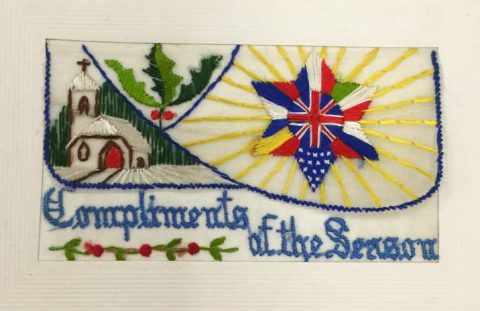
Special occasion cards for Christmas, New Year’s and Easter were also common and bore traditional messages of “A Happy New Year” and “Christmas Greetings.” See Photograph 2 – The Compliments of the Season. The “Compliments of the Season” card depicts a beautiful snowcapped church and did not reflect the horrors that surrounded the soldiers (and the maker of this card).
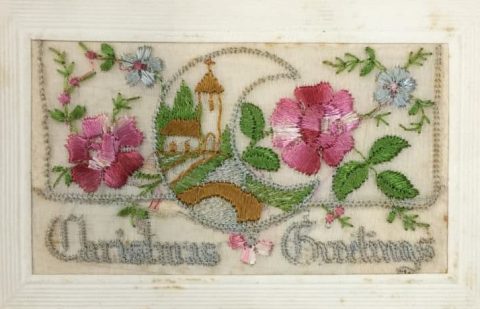
The Silks were predominantly embroidered by the women of France and Belgium. The quality of the early silks (circa 1915) was considered quite high. However, with increased demand from about 1917 (and with the probable shortage of materials), workmanship understandably declined. Initially, the cards were manufactured as a cottage industry. Later, (and in order to meet increasing demand), postcard companies employed women to produce silks on a rough assembly line basis. The embroidery was completed in the women’s homes and then sent to the factories for cutting and mounting on postcards.
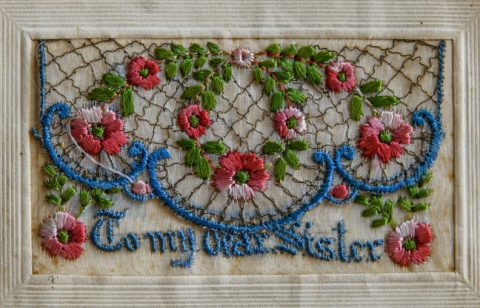 In his book, Laffin (1988) states that while the women who laboured over the silks were doing so as a business, there was also much emotion and sensitivity within their work. A Frenchwoman who lived near Arras and embroidered silks between 1916 and 1918 explained to Laffin “that a design could take up to four to eight hours to complete”. She would then sell the card direct to a soldier for as little as a few francs. The women who were directly employed by a postcard producer received a relative pittance. However, the income derived would have been a useful supplement to the family income during these troubled times.
Tomczyszyn (2000) writes that all the cards have similar a construction: a white silk rectangle on which the message and design were embroidered. The embroiderers began with long strips of silk about 190 centimetres by 11 centimetres. Generally, this length of fabric could accommodate up to twenty-five designs. The strips were starched before embroidery began. The silk portion of the card measures approximately 6 centimetres in height; and 11 centimetres in width. When completed the silk inserts were sent to the factories for finishing. The silk embroideries were then inserted into a card. The border surrounding the embroidery was embossed to simulate lace, geometrical, or blossom and foliage designs. The alternate side was a regular postcard back. Some postcards were made with small envelopes or flaps (See Photograph 3 – Dragonfly) which could contain a silk handkerchief or a smaller card for a personal message.
There is little information on the manufacture of the cardboard portion and cards appear to have been sourced from a number of countries including France, England, and Switzerland.
In many cases the silks were not sent directly through the mail but enclosed in a letter or packages to home. It would seem that the soldiers also appreciated the beauty and workmanship of the silks as they were often kept as souvenirs and mementoes. Silks from the First World War can be bought today and given their age, are in remarkable condition. Their condition highlights the sentimental value and care that was given to these items.
Despite a Second World War being fought in similar geographical regions, the Silk Postcard never reached the same level of demand as from the First World War. Historians posit that humanity lost its innocence in the First World War 1 and it could be argued that the Silks were synonymous with that innocence. These little cards which are stitched with such care, highlight how beauty can be created in the ugly.
Sources & Further Reading
Alvey, E., (2013), Collection Spotlight for November: ‘Postcards from the Front’, from the JD Fryer Collection
Australian War Memorial Research Centre, (2000). Guide to the Silk Postcard Collection.
Laffin, J., (1988). World War 1 in Postcards. Melbourne: Sun Books/MacMillan.
Tomczyszyn, P., (2000). With Love from the Trenches: Embroidered Silk Postcards of the First World War, Material Culture Review, Volume 51, Spring/Printemps 2000