Background
Hungarian folk embroidery is a beautiful art, rich in design, colour combination and stitches. With more than 20 folkloric regions in Hungary, each region’s unique folk art was created according to the availability of textiles and threads, which influenced the colours, stitches and types of design.
General characteristics of Hungarian embroidery include proportioned patterns replete with delicately stylised flower motifs, variations of large and small designs, and vivid and sometimes contrasting – but always harmonious – colours, which serve to create a tapestry that is pleasing to the eye. In Hungarian folk embroidery, colouring and stitches are always balanced: with many colours, few stitches are used; while monochromatic works have a multitude of stitches.
Matyo work
The Matyo area is located in the northern part of Hungary. The word ‘Matyo’ comes from the name ‘Mátyás’ (legend says that King Mátyás gave Mezökövesd the title of ‘free royal town’ in 1464) and was originally used by the population of the surrounding Protestant villages to distinguish the Catholic Matyo people from themselves.
The Matyo area is united and distinguished from other settlements in the region by its colourful costumes, famous folklore art, and lives tightly interwoven with traditions of the inhabitants. Matyo embroidery is done either on a white or black background fabric. Embroidery started to appear on folk costumes in the 1870s, replacing the earlier simple geometric cross-stitch designs. Today’s embroidery is done mainly in satin stitch, but in the past a wider variety of stitches was used – including chain stitch and the distinctive Matyo ‘figure 8’ stitch.
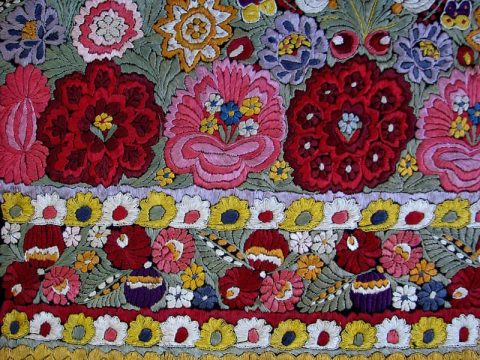
The apron’s embroidery is completed on black fabric. The apron, or ‘surc‘ formed part of the folk costume for both young men and women.The stylised roses and tulips commonly seen in Matyo embroidery were originally used by master craftsmen (szur-makers and furriers).
Made of black satin or silk, the aprons often featured embroidery arranged in rows, with little background showing between motifs.This type of work is also referred to as ‘szucsos’ embroidery (in reference to the furriers and ‘szucs‘ masters).
Although most Matyo women and girls embroidered, not everyone could draw. Patterns were drawn on the cloth freehand, and this was done by professionals called ‘iroasszonyok‘ – writing women – or ‘rajzoloasszonyok’ – drawing women. They used a pencil for white background fabrics and chalk for black. Many of the best writing women came from families of szur-makers or furriers, including the famous Bori Kis-Janko illustrations.
The embroidered band on our apron is 45cm deep and is made from black velvet. The threads are off-white, yellow, orange, 4 shades of pink, and 3 shades of blue, purple and green. The green has faded considerably, while other colours have softened, the pinks becoming more apricot. A black fringe at the bottom measures 17cm deep.
Stitches: Satin, buttonhole and chain stitch.
Known Provenance: Purchased in Brisbane in the early 1980s from Milton Cater.
Source
Embroidery by Emese Kerkay