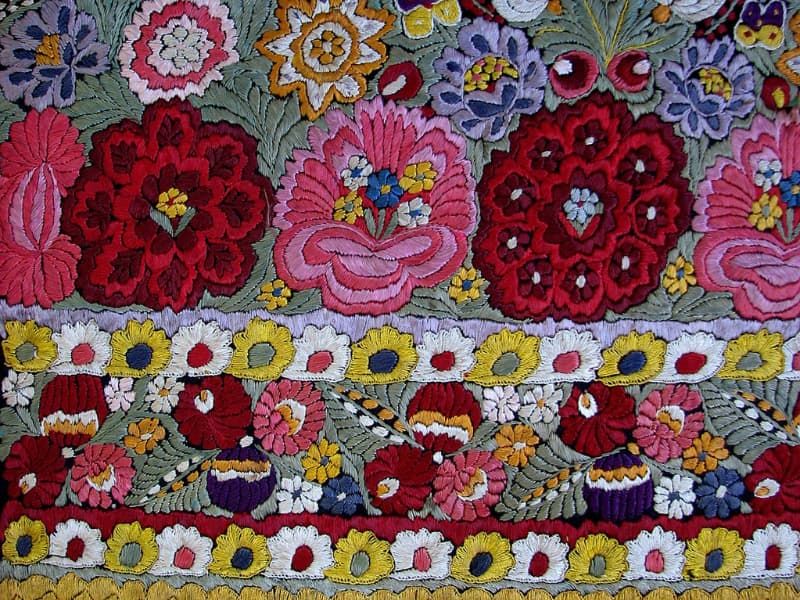
What is embroidery? Quite simply, it is the decoration of a textile using needle and thread. The origin of the word – the French word broderie – means embellishment.
Embroidery has ‘been around’ for a very long time. Fossilised artefacts and textiles embroidered hundreds, even thousands, of years ago have been found in China, India, Sweden and the Near East. During the medieval Christian and Islamic eras, embroidery helped to create stunning vestments.
In fact, embroidery was rapidly becoming a way to decorate artefacts and garments not only in places of worship and royal establishments but also in wealthier people’s homes. Poorer folk, who had to work very hard to survive, did not have the time or energy for such indulgences.
By the start of the 20th century – when many garments and household items were still being made by hand – embroidery, along with other types of needlework, had become an established skill among women – and some men (leastwise in the United Kingdom). Though the designs of the Victorian era tended to be sombre, a new style was briefly celebrated with the advent of the new century: Art Nouveau, which saw wool often used to embroider botanical images, especially flowers.
The Roaring Twenties
The ‘Roaring Twenties’ – the Jazz Age – was a decade when the world was recovering from the horrors and deprivations of a ‘war to end all wars’. People dared to start feeling optimistic and hopeful for the future.
In many respects, the 1920s was the birthplace of Modernism, reflected in all forms of the arts, including embroidery. The decade introduced a new design aesthetic, one that celebrated the simplicity and symmetry made possible by the use of machines.
The decade coincided with the surge of the renowned, but brief Art Deco period, which took its name from the 1925 Exposition Internationale des Arts Décoratifs et Industriels Modernes, held in Paris. The Art Deco aesthetic included such typical features as:
- streamlined elegant designs, their sleek sophistication contrasting with the flowery ‘pretty’ styles of the Art Nouveau period,
- simplicity,
- striking geometric shapes (often symmetrical): triangles, zigzags and trapezoids,
- vibrant, rich colours: primary colours and pinks and bright yellows, and
- sunrise or sunburst motifs (perhaps signifying a ‘new dawn’).
Typical embroidery subjects were birds (such as flamingos), stylised feathers, flowers (often in vases with geometric designs), household items such as glasses – even cars and planes. These were typically framed by an embroidered symmetrical design.
Typical items embroidered included pillow shams; wall hangings; towels; table linen, such as cloths, napkins and placemats; tote bags; chair backs; pieces to frame; and clothing, including the collars, yokes and pockets of shirts.
1920s Fashion
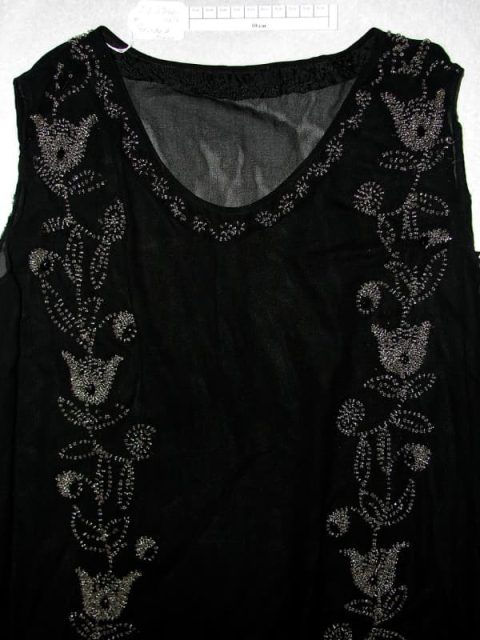
Fashion in the 1920s emphasised a simplicity and comfort till then not seen: shorter skirts and simpler dresses for women, casual suits for men, even so-called romper suits for babies.
While tubular dresses (favouring taller, slim women!) were typically simple and uncluttered, evening dresses were invariably spectacular sights. Heavily embroidered and/or ornamented overlays (featuring beaded pearls, rhinestones even bits of metal and glass) might be a stunning offset to the simple silhouette of the dress underneath.

Aprons
Aprons were an essential item for women in the 1920s (and beyond) to protect their clothing and so were usually full length. They were often embroidered, even if only simple everyday aprons. A translucent fabric, such as organza, decorated with fine embroidery might be used for more formal occasions.
Patterns in the 1920s
Embroidery patterns were of three types:
- replicated by a process called ‘pouncing’; the design, first traced on stiff paper, was perforated with pin holes over which a powder was then rubbed so as to leave a chalky outline on the fabric
- formed by ironing a paper transfer onto a fabric or, if the ink proved to be too faint, tacking the outline of the design onto the fabric and then tearing the paper away
- provided on fabric with the design printed on it (stamped linen).
Embroidery Hoops
Embroidery hoops in the 1920s (and 1930s) were of different types:
- hoops with the inner hoop wound with cotton fabric to better grip the outer hoop
- hard rubber hoops
- metal hoops where the spring-loaded outer hoop was kept tightly pressed against the inner hoop
- wooden hoops with a tightening screw, which we still use today.
Threads
Most embroidery threads were made of linen or silk until the start of the twentieth century. After World War I, colourfast cotton threads became widely available. At first, cotton threads were available only in black, white and red, which is why Redwork was so popular in the 1920s.
100 Years of Embroidery
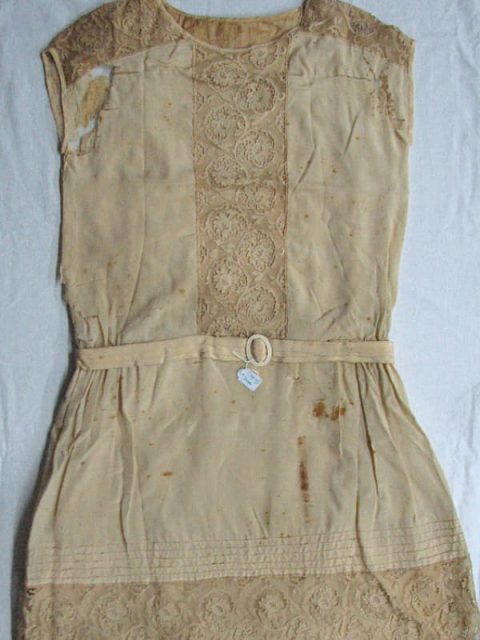
The simplicity of design in the 1920s made it easy for many garments and items for the home to be made at home. Fashion was becoming more ‘democratic’! Embroidery helped sewers to customise these home-made fashions as something both attractive and unique.
Much has changed over the last 100 years for embroiderers, kickstarted by the amazing 1920s decade:
- the widescale development of sewing and embroidery machines
- the mass production of paper patterns, catalogues and a diverse range of embroidery supplies
- the plethora of embroidery books and instructional classes, available both face and face and online.
Clearly, despite the many changes over the last century, the love of this treasured art form is here to stay.