Featured is a sampler of Dorset Buttons donated to the Guild by Iris Dibley.
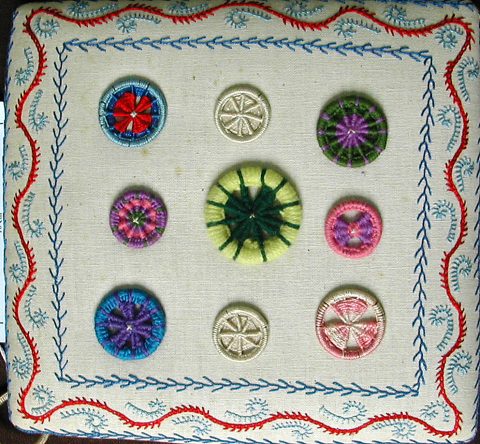 Dorset Buttons are probably the most widely known of the needle lace buttons. They are constructed from rings that can vary in size from 10mm to 30mm (or more) and made from a variety of materials, including wood, bone, metal or plastic. These are then covered in buttonhole stitch with thread or fine cord. Thread types can include crochet cotton, lace-weight linen, fine tapestry wool, perle cotton, buttonhole twist and metallic thread.
While many covered button styles can be found, Munroe (2021) specifies the 4 steps for constructing a traditional Dorset Button are:
- Casting (covering the ring with blanket stitches)
- Slicking (turning the cast ‘bumps’ to the inside of the ring)
- Laying (wrapping thread spokes)
- Rounding (filling in the spokes) – the variation in how the spokes are filled forms the basis for the many current regional and contemporary designs.
The history of the Dorset Button dates to the early 1600s. An Abraham Case is credited with developing what was to prove a lucrative cottage industry that extended over a 200-year period and provided employment for generations of families in the Dorset area.
Abraham was a professional soldier who spent time in Europe fighting the Thirty-Year War (1618 – 1648). While in Europe, it is thought that 2 events influenced his development of the Dorset button:
- watching French soldiers replace buttons on their uniforms by twisting a piece of fabric over a form and then fastening it with a piece of thread
- lacework buttons from Brussels.
On his return to England in about 1622, Abraham settled in Shaftesbury and so began the Dorset Button industry. Buttons at this time were constructed from fabric, sheep’s horn and thread. The ‘High Tops’ were thought to be the first of the Dorset Button types, made from a thin disc of sheep’s horn to form the base, with a piece of linen pulled and twisted to form a conical shape. This shape was then embroidered over with a very fine thread. A flatter version of these buttons is called the ‘Dorset Knob’.
In 1698, an Act was passed to prevent the making or selling of buttons ‘made of cloth, serge, drugget, or other stuffs’. This legislation protected button makers who worked in silk, mohair and gimp, as well as thread buttons, which were worked with a needle (such as the Dorset Button).
Abraham’s grandson, Peter, took over the business in the first half of the 1730s and it is thought that he introduced the (non-rusting) metal rings into the button’s construction. Under Peter’s stewardship, the business continued to expand. He brought in John Clayton, a businessman from York, to manage the business. John was instrumental in arranging for buttoners, mainly women, to work from home.
In the early 1700s, the firm employed approximately 700 women and children. By the end of the century, these numbers had swelled to around 4,000 in the Shaftesbury area and another 3,000 in the Blandford area. Unfortunately, though, this cottage industry could not be insulated against the Industrial Revolution. Handmade buttons were replaced by the introduction of pearl, bone and cloth buttons, which could be manufactured more cheaply and efficiently by machine.Buttoners were no longer needed and the skill of buttony was in threat of being lost. By the mid 1850s, many button makers had moved to alternative occupations such as needlewomen and glovers.
In the early 1900s, Florence, the Dowager Lady Lees, was responsible for saving the art of making Dorset Buttons. She visited farms and cottages all over Dorset to discover how they were made and sought to revive the industry at Lytchett Minster. She established a small business that specialised in the production of ‘Parliamentary’ buttons for Dorset MPs. Buttons were produced in the MPs’ respective constituency colours. In 1908, these buttons were in full production. This revival ended due to the outbreak of the First World War.
Today, however, Dorset Buttons are a heritage craft and the skill of buttony continues. Many people make thread and fabric buttons for their own enjoyment, while some artists use buttony techniques to embellish art pieces.